If you are reading this, you are not shopping for a camera. You are deciding how to put your brand on one — and you have hit the two acronyms every Shenzhen factory throws around: OEM and ODM. Most supplier pages explain them as dictionary definitions and move on. That does not help you place an order. This guide answers the question underneath the acronyms: given your stage, your order size and what you want to own, which model should you actually ask for?
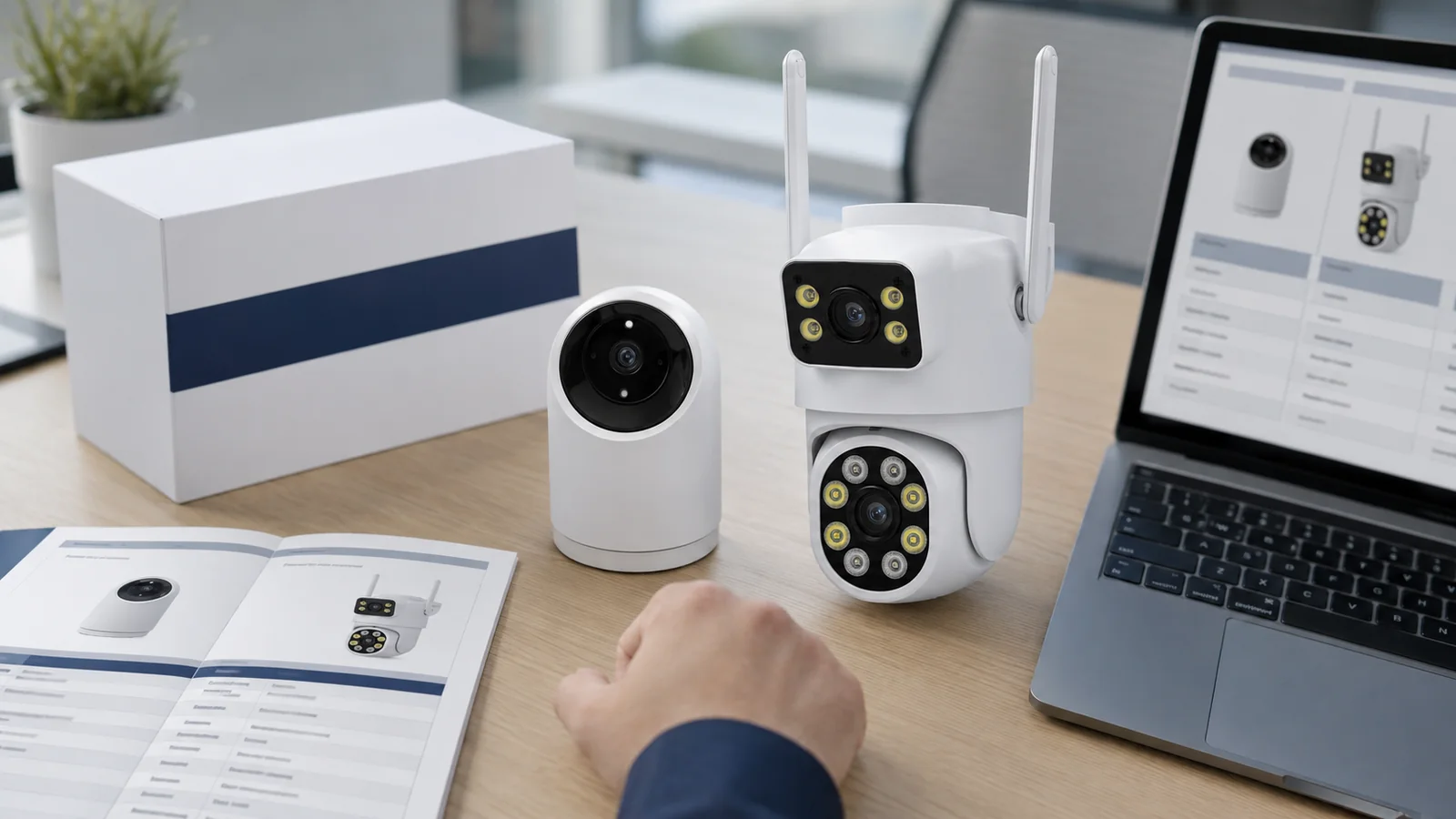
Who this is for: distributors adding cameras as a new category, e-commerce sellers moving off generic stock, and brands that want a real own-brand line rather than a relabeled box. If you are still choosing between stock and branded at all, start with Public Mold vs Private Mold AI Cameras first; this article assumes you have decided to brand and now need the sourcing model.
The plain-language difference (no jargon)
Strip away the supplier-speak and there are really three options, not two:
- OEM (Original Equipment Manufacturer) — you bring the design, the factory builds it. You own the product concept; the factory manufactures it to your specification. In cameras this usually means you have your own housing, your own requirements, sometimes your own firmware behavior, and the factory produces it.
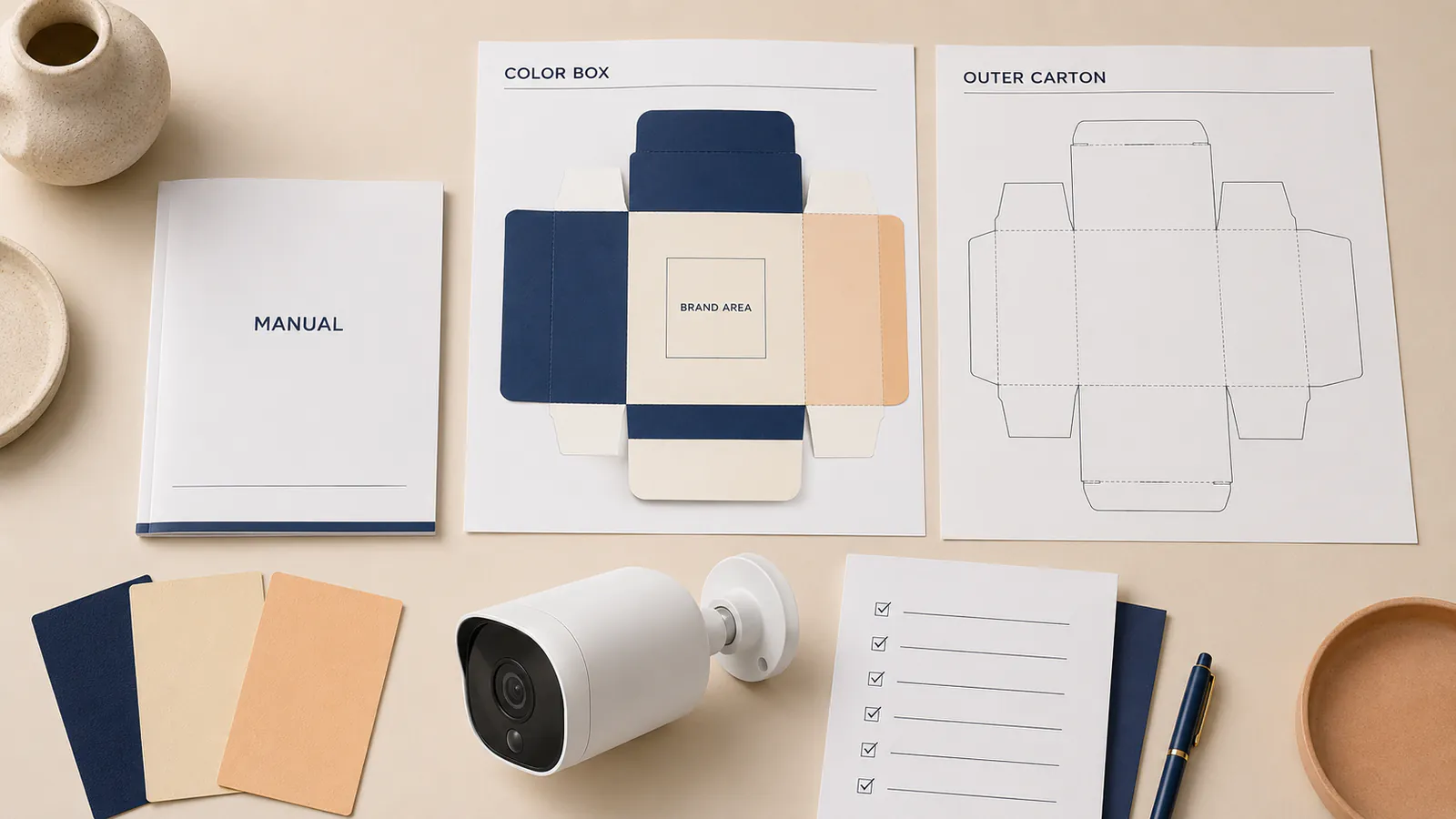
- ODM (Original Design Manufacturer) — the factory already has the design, you brand it. You start from a camera the factory already engineers and tools, then customize the parts that carry your brand: logo, color box, manual, app and cloud account, sometimes housing color or feature mix. You skip the cost and time of designing hardware from zero.
- White-label — the lightest end of ODM: a finished product sold under your brand with minimal change, plus an app and cloud that run under your name. Fastest to launch, least differentiated.
For most camera buyers in 2026, “OEM vs ODM” is really a question of how much you design versus how much you adopt — and the honest answer for a first branded line is almost always closer to ODM, because designing camera hardware from scratch is a six-figure, twelve-month commitment most brands do not need.
The procurement questions that actually decide it
Forget the definitions. The model you should ask for falls out of five questions you already know the answers to.
1. Do you have your own hardware design — or just a brand?
If you have an industrial-design team and a housing you own, OEM lets you protect that. If what you actually own is a brand, a channel and a customer base — not a CAD file — ODM is the honest fit. You get a proven camera and put your identity on it, instead of paying to reinvent a pan-tilt housing that already exists in a hundred variations.
2. How large is your first order, realistically?
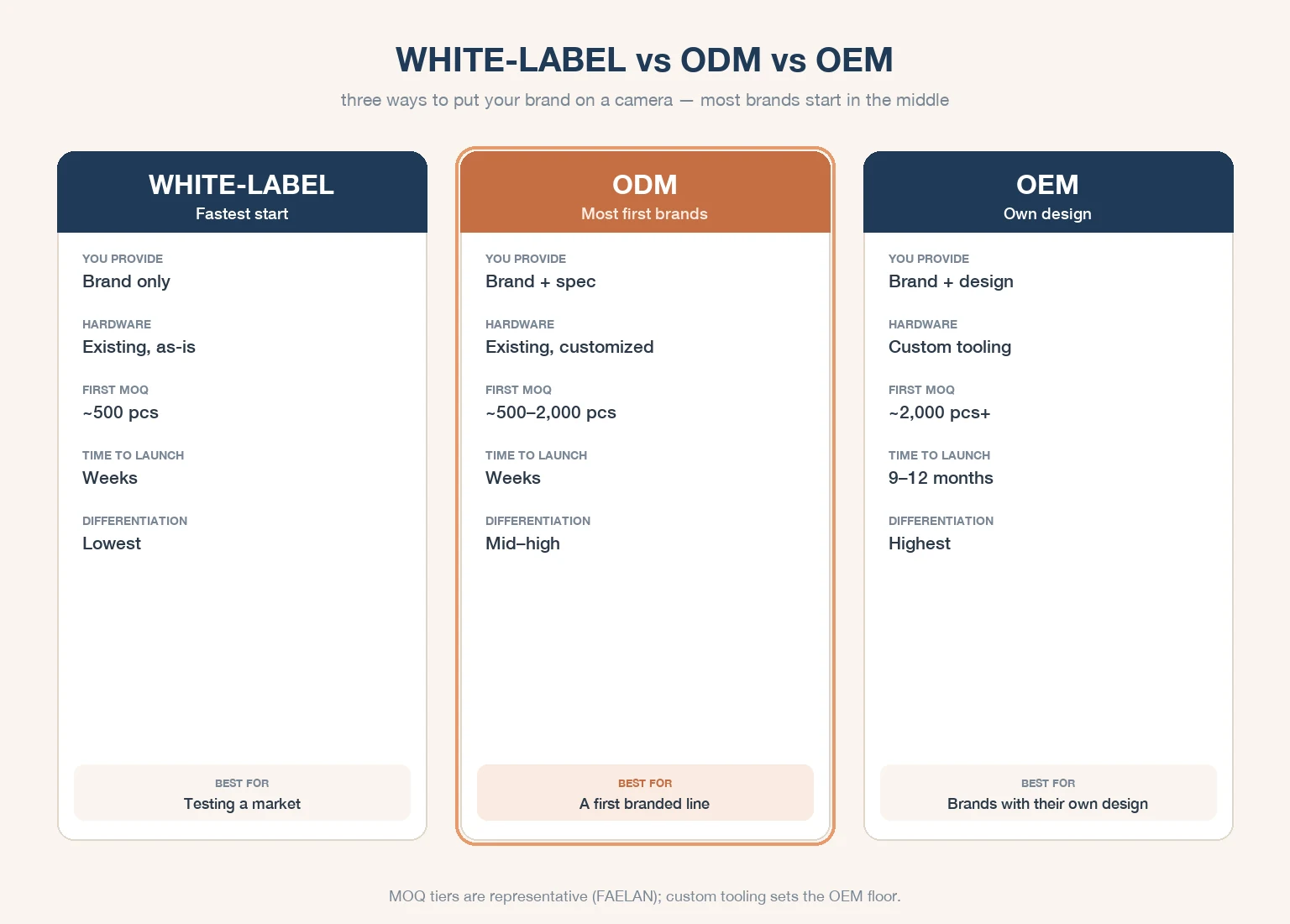
This is where OEM and ODM separate hard, because tooling has a floor. Custom hardware (true OEM) needs new molds, and molds are paid for in volume. ODM reuses existing tooling, so the entry order is far smaller. Representative tiers from a Shenzhen base like FAELAN: stock from ~100 pcs, white-label platform from ~500 pcs, OEM-branded from ~2,000 pcs. If your first order is in the hundreds, OEM tooling economics will not work yet — and a supplier worth keeping will tell you that instead of taking a deposit.
3. Do you need to own the app and the cloud?
Cameras are no longer a hardware-only purchase, and this is the question most first-time brands underestimate. Ask: when your customer opens the app, whose name is on it? A real branded program puts your logo on the app, your cloud account, and your subscription plans — with on-device AI detection on every unit and an optional cloud generative-AI care agent your brand can sell as a subscription. That software layer is where repeat margin lives, and it is an ODM/white-label capability, not something you get by ordering bare hardware. We cover the stack itself on the white-label AI platform page.
4. Which markets are you certifying for?
Certification scope is decided per model and per market, and it changes the OEM-vs-ODM math. A new OEM design has to be certified from zero for every market you sell in. An ODM model that already holds the certifications — FCC, CE, RoHS, ISO 9001 — and supports the regional requirements (IFT for Mexico, Anatel for Brazil, ENACOM for Argentina) saves you months and a testing budget. If your timeline is a season, not a year, inherited certification is often the deciding factor.
5. How fast do you need to be on a shelf?
OEM from a blank sheet is a 9–12 month arc: design, tooling, sampling, certification, production. ODM compresses that to weeks for samples and a single production cycle, because the hard engineering is done. If a buyer is waiting on your catalog this quarter, the model chooses itself.
The real cost difference — beyond the unit price
The OEM-vs-ODM choice is usually framed as a price comparison, which is exactly the wrong lens. The unit price is the smallest of the differences. Three larger costs decide whether a model is affordable for you:
Tooling and engineering (the OEM tax). A custom housing means new injection molds, and molds are a fixed cost paid before a single unit ships. Spread over a small first order, that cost dwarfs any per-unit saving. Spread over hundreds of thousands of units, it disappears. This single fact is why OEM economics only work above a volume floor — and why ODM, which reuses paid-for tooling, starts so much cheaper.
Certification (paid in money and months). Every new design has to be certified for every market it enters, and testing is neither fast nor free. An ODM model that already carries FCC, CE, RoHS and ISO 9001 and supports regional approval requirements hands you that work pre-paid. With OEM you are buying the certification timeline as well as the camera.
Time, counted as a cost. A 9–12 month OEM arc is not just slower; it is a season of shelf space and cash you are not earning while a competitor on ODM is already selling. For most brands the cost of being late outweighs the cost of shared hardware.
Put together, the honest comparison is not “OEM unit vs ODM unit” but total program cost to a sellable, certified, on-shelf product — and on that measure, ODM wins for almost every buyer who is not already running high volume on their own design.
OEM vs ODM vs white-label: the decision at a glance
| White-label | ODM | OEM | |
|---|---|---|---|
| You provide | Brand only | Brand + spec preferences | Brand + hardware design |
| Hardware | Existing, as-is | Existing, customized | Custom / new tooling |
| Typical first MOQ | ~500 pcs | ~500–2,000 pcs | ~2,000 pcs+ |
| Time to launch | Fastest (weeks) | Fast (weeks) | Slowest (9–12 months) |
| Your branding | App, cloud, box | App, cloud, box, manual, housing options | Everything, incl. hardware |
| Certification | Inherited | Inherited, scope-confirmed | New, per market |
| Differentiation | Lowest | Mid–high | Highest |
| Best for | Testing a market | First branded line, scaling sellers | Established brands with their own design |
Which one fits you — by buyer profile
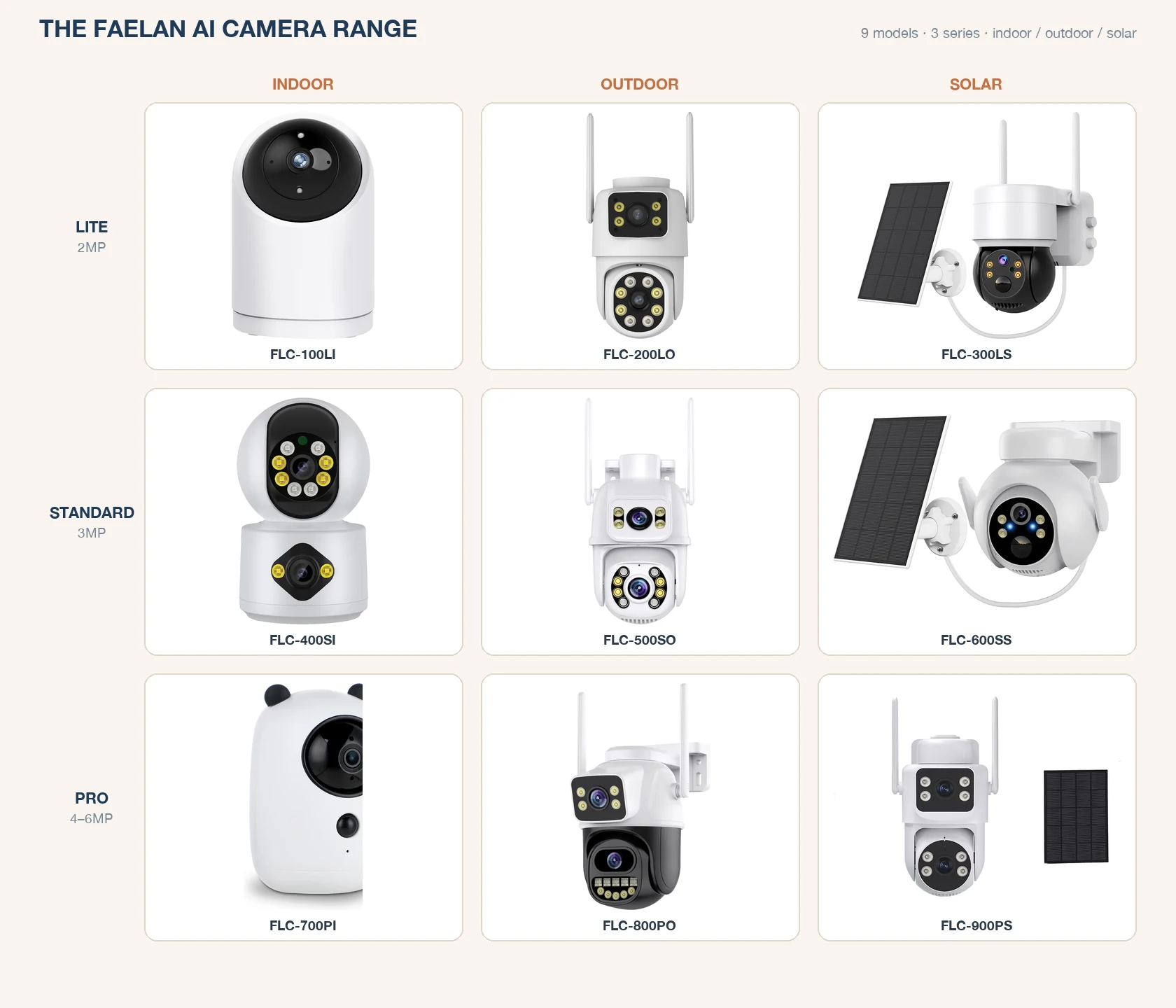
- Distributor entering the camera category: ODM. You need a credible lineup (indoor, outdoor, solar) under your brand without betting on custom tooling. Lineup breadth and inherited certification beat bespoke hardware.
- E-commerce seller moving off generic stock: White-label to start, ODM as volume builds. Get your brand on the app and box first; customize hardware once the numbers justify it.
- Brand with a real design team and a housing you own: OEM. This is the case where paying for tooling protects something genuinely yours.
- Operator or large retailer planning a multi-year line: ODM now, OEM later. Launch on proven hardware, then graduate specific SKUs to custom tooling once they earn the volume.
The pattern across all four: most brands should start at ODM/white-label and earn their way to OEM — not the reverse. We documented exactly that arc in a real engagement — see how a LATAM distributor built an own-brand camera lineup.
Questions to put to a supplier before you commit
The OEM-vs-ODM decision is only as good as the answers you get. Bring this list to the first call — a supplier who answers all of it cleanly is one you can build a program on; hesitation on any line is information.
- For my volume, do you recommend OEM, ODM or white-label — and why? A supplier who pushes OEM on a 200-piece order is selling tooling, not advising you.
- What changes between an ODM and an OEM quote for the same camera? You want the cost and time delta in writing, not a vague “OEM is more premium.”
- What is the working MOQ for the first run, and is it negotiable? New accounts and standing accounts are different conversations; ask which one you are getting.
- Whose brand is on the app and cloud, and can the AI features ship under my name? Settle software ownership before hardware specs.
- Which certifications does this exact model already hold, and which are needed for my markets? Per SKU, per market, in writing.
- What is the realistic timeline from order to my warehouse — samples, production, shipping? With a remedy clause if it slips.
- Can I see a reference customer who started ODM and reordered? The reorder is the only review that counts.
Common mistakes when choosing between OEM and ODM
- Asking for OEM to look serious. Insisting on custom tooling for a first order in the hundreds burns budget and time on differentiation your buyers will not notice yet.
- Treating the app as an afterthought. If the camera works but the app carries the factory’s brand, you have rented a customer, not won one. Settle app/cloud ownership before hardware.
- Forgetting certification is per SKU. A certified flagship does not certify the entry model beside it. Confirm scope for every model you list, the same discipline covered in the wholesale buyer’s guide.
- Comparing unit price across models. An ODM unit and an OEM unit are not the same product; the cheaper line item is not the cheaper program once tooling, certification and time are counted.
- Buying 4G “just in case.” Confirm what the lineup actually ships. A current WiFi line with an RJ45 wired-backup port and local microSD recording covers most retail and residential use; a dedicated 4G variant is a separate product decision.
Frequently asked questions
What is the difference between OEM and ODM security cameras?
With OEM, you bring the hardware design and the factory manufactures it to your specification. With ODM, the factory already engineers the camera and you brand and customize it — logo, packaging, app, cloud and selected hardware options. OEM means you designed it; ODM means you branded an existing design.
Is OEM or ODM better for a first branded camera line?
For most first lines, ODM (or white-label) is the better fit. It avoids the tooling cost and 9–12 month timeline of custom hardware, starts at a much lower MOQ, and inherits existing certifications — letting you launch a branded lineup in weeks rather than a year. OEM makes sense once you have your own design and the volume to justify tooling.
What is the typical MOQ for OEM vs ODM cameras?
Order floors vary by factory, but a representative structure is stock from around 100 pieces, white-label platform programs from around 500 pieces, and OEM-branded production from around 2,000 pieces, because custom tooling has to be amortized over volume. First-run MOQs are often negotiable with a factory that wants a long-term account.
Can I get my own app and cloud with ODM cameras?
Yes — a proper ODM or white-label program puts your brand on the app, your own cloud account, and your subscription plans, with on-device AI detection standard and an optional cloud AI layer you can sell as a subscription. Confirm app-store listing and language support for your markets before committing.
Does ODM mean my cameras look the same as competitors’?
Not necessarily. ODM customization can include housing color, feature mix, packaging and the full app/cloud experience, so two brands can ship visibly different products from the same engineering base. The shared part is the underlying hardware platform, which is also what makes ODM affordable and fast.
How long does OEM vs ODM production take?
ODM samples typically ship in days and a first production run completes in a single cycle, because the engineering is done. OEM from a new design is a 9–12 month arc covering design, tooling, sampling, certification and production. Timeline is often the deciding factor between the two.
Decide your sourcing model with us
If you are weighing OEM vs ODM for a camera line, the fastest way to an answer is to tell us your stage. Start your inquiry with your market, target volume and whether you have a hardware design, and the FAELAN team will recommend OEM, ODM or white-label — with the SKU mix, MOQ, certification scope and app/cloud plan that fit — before any commitment. The mechanics live on the OEM / ODM solutions page.